

As artificial intelligence reshapes the future of work, new roles and opportunities are emerging across the AI-data value chain. From generating and annotating training data to evaluating model outputs and applying specialised domain expertise, this work draws on a growing range of skills and competencies.
For India, this presents an opportunity to build a more inclusive, future-ready workforce, particularly for women and workers beyond major technology hubs. But realising this potential requires more than creating new jobs. It calls for recognising the skills workers acquire, connecting them to industry demand and creating meaningful pathways for learning and career progression.
HOW CAN INDIA TRANSLATE THESE EMERGING OPPORTUNITIES INTO RECOGNISED SKILLS, SUSTAINABLE LIVELIHOODS AND LONG-TERM CAREER PATHWAYS?
To explore this question, GxD hub and The/Nudge convened a virtual roundtable on October 7, 2026, bringing together senior representatives from government, industry, skilling institutions and civil society to discuss the AI-Data Skills Framework (AISF) and its practical applications.
The discussion featured perspectives from Shikha Dhahya, Joint Director, IndiaAI Mission, Ministry of Electronics and Information Technology (MeitY), and Dr. Alok Tripathi, Director, National Institute of Electronics & Information Technology (NIELIT), alongside representatives and experts from IndiaAI, National Skill Development Corporation, Firstsource, B2R Technologies, EkStep Foundation, IT for Change and Myna Mahila Foundation.
Developed by GxD hub in collaboration with The/Nudge under the Sanmati 2.0 initiative, the AI-Data Skills Framework (AISF) establishes a common skills language for emerging AI-data roles. Grounded in research with workers across gig, platform and BPO environments, it identifies five worker personas: Data Associate, Data Enricher, Data Auditor, Data Analyst and Data Specialist, and maps their competencies to India’s National Skills Qualifications Framework (NSQF) and National Credit Framework (NCrF).
The roundtable examined how the framework could inform skilling programmes, workforce planning, recruitment and credentialing, while identifying the institutional partnerships and worker-centred approaches needed to translate skills recognition into meaningful opportunities.
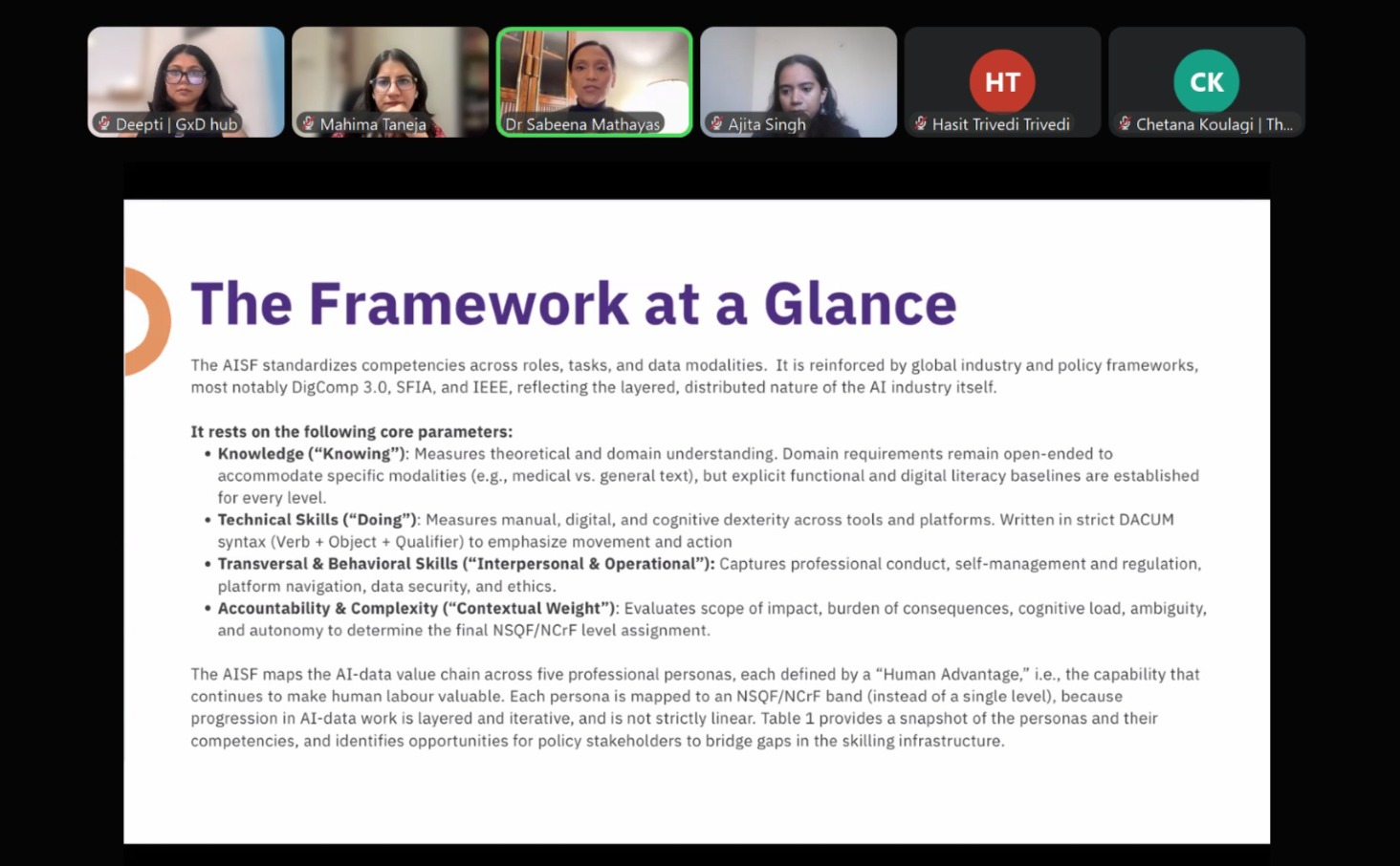
The GxD hub team presenting the research underpinning the AI-Data Skills Framework (AISF) at the stakeholder roundtable.
FIVE KEY TAKEAWAYS THAT EMERGED FROM THE DISCUSSION:
1. A common skills language can connect workers with emerging industry demand
Industry and civil society representatives highlighted a common gap: workers often possess skills that are not reflected in how they describe their work or how employers identify talent.
For instance, Kirti Shukla, Programme Manager, Myna Mahila Foundation observed that women performing AI-data tasks often identify themselves simply as gig workers, without necessarily knowing the occupational terminology used by industry. Myna Mahila seeks to address this barrier through AI Contributor certificates, helping workers in articulating their experience using the framework. Hasit Trivedi, President – Chief Digital and AI Officer, Firstsource similarly noted that workers’ resumes may not adequately reflect the competencies they have acquired.
The AISF offers a starting point for bridging this gap. A shared vocabulary can make workers’ experience more visible while helping employers describe roles, identify relevant competencies and recruit talent.
Pranay VK, Startup & Communications Strategy Lead, EkStep Foundation also emphasised that credibility must go along with enhancing the discoverability of workers engaged in the AI-data value chain and related tasks. The value of a skills taxonomy ultimately rests on whether employers recognise and use it in job descriptions, hiring decisions and assessments.
The opportunity: Move beyond defining skills to encouraging their adoption across recruitment, training and workforce systems.
2. Career progression needs multiple pathways, not a single ladder
While the AISF identifies five worker personas, participants cautioned against interpreting them as a fixed progression ladder.
Research presented by Dr. Mahima Taneja and Dr. Sabeena Mathayas of GxD hub highlighted that movement between roles is often limited. Progression may occur through people management or project responsibilities rather than through transitions from one persona to another.
Dhiraj Dolwani, CEO, B2R Technologies, described how workers progress through different routes within organisations: developing subject expertise, moving into quality assurance, mentoring colleagues or managing project delivery. Some transitions build naturally on existing competencies; others require structured training and additional experience.
GxD hub’s research similarly found that progression often takes place through people and project management rather than movement between technical roles.
Dr. Alok Tripathi, Director, Skilling, NIELIT, emphasised the need for modular, stackable learning pathways that allow workers to build on what they already know. Recognition of Prior Learning (RPL) could be particularly valuable for workers who have developed skills on the job but lack formal credentials. He also recommended practical, task-based assessments using realistic datasets to demonstrate competencies.
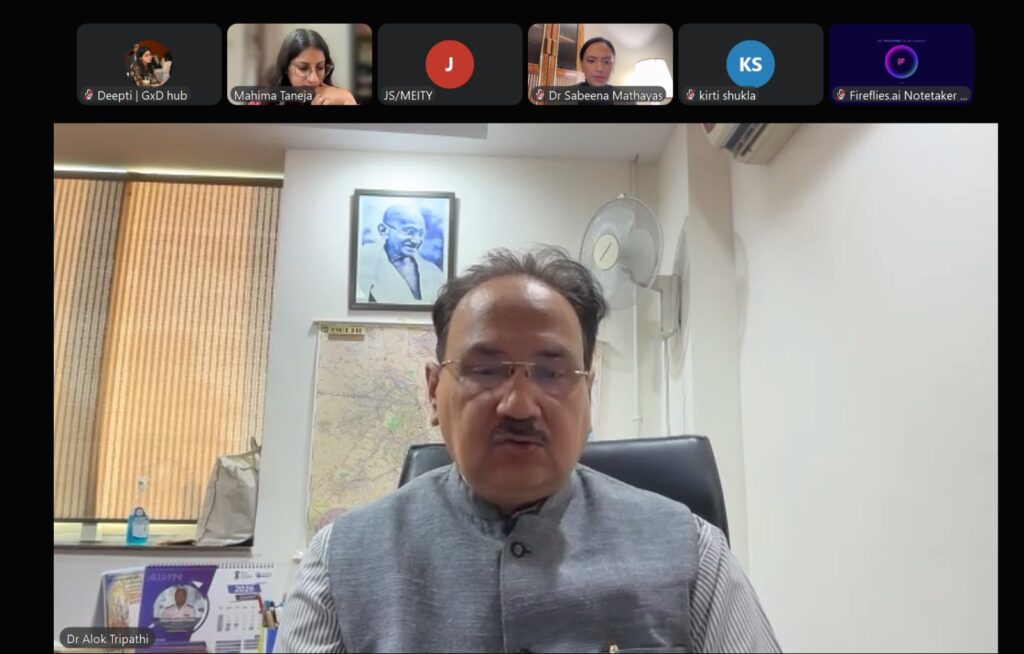
Dr. Alok Tripathi, Director, Skilling, NIELIT, on connecting skills development with emerging workforce needs.
The implication is that career pathways must accommodate different aspirations and forms of progression, including specialisation, technical advancement and supervisory responsibilities.
The opportunity: Translate the framework into flexible learning and assessment pathways that recognise existing experience and support different career aspirations.
3. Skills frameworks must evolve alongside AI technologies and jobs
Industry participants highlighted how quickly AI-data work is changing.
Hasit Trivedi noted a growing shift from preparing inputs for AI systems towards evaluating their outputs. Agentic AI, for instance, creates demand for workers who can define processes, test agents, validate outputs and assess performance. Physical AI and robotics may create further requirements for collecting and interpreting complex task and activity data.
These developments suggest that the next generation of AI-data roles may extend beyond conventional annotation and labelling.
Kartik Suri, General Manager – Future Skills, IndiaAI, similarly stressed the importance of moving from narrow, task-specific training towards continuous capability building as technologies and industry requirements change.
The AISF can provide a foundation for this evolution, but its relevance will depend on continued engagement with industry and workers to identify emerging competencies and occupational pathways.
The opportunity: Treat the framework as an evolving taxonomy, with scope to incorporate new areas such as AI evaluation, agent testing and robotics-related data work.
4. Skills recognition needs credible assessment and institutional support
Participants welcomed the alignment of AISF competencies with national qualification frameworks, while emphasising the importance of implementation.
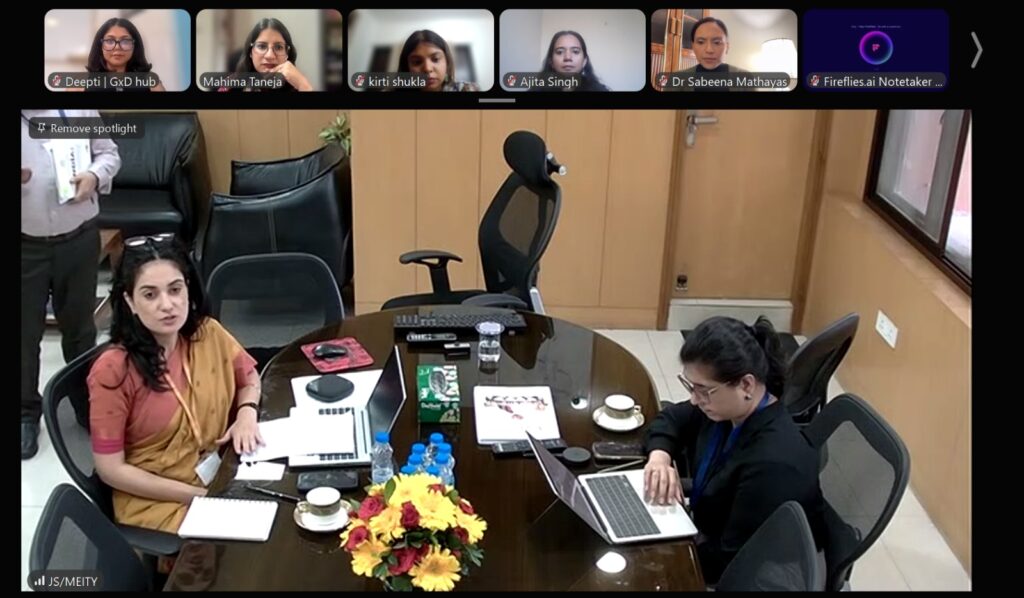
Shikha Dhahya, Joint Director, IndiaAI Mission, bringing the policy perspective to the discussion on India’s AI-data skills landscape.
Shikha Dhahya, Joint Director, IndiaAI Mission, highlighted its relevance to the FutureSkills pillar of the IndiaAI Mission and the need for collaboration across government, industry and non-profit organisations to expand skilling efforts.
Dr. Alok Tripathi identified opportunities to translate the framework into competency-based curricula, modular training and recognised qualifications.
But who should assess and certify these competencies?
Pranay suggested developing a decentralised network of assessors to extend recognition beyond major cities. Anita Gurumurthy, Executive Director, IT for Change emphasised the importance of independent institutions and public credibility, particularly for activities such as AI testing, benchmarking and auditing.
Together, these perspectives highlighted the distinction between mapping competencies and establishing systems that employers, workers and regulators can trust.
The opportunity: Build credible assessment and credentialing arrangements, supported by national qualification systems and accessible to workers across different geographies.
5. Women’s participation requires more than access to flexible work
The discussion also examined what meaningful inclusion looks like within the AI-data economy.
Research presented by GxD hub showed that women enter AI-data work for different reasons, including flexibility, income and proximity to home. Many acquire competencies through on-the-job learning, supported by community facilitators and trusted intermediaries.
Kirti Shukla highlighted the importance of trust in connecting women from marginalised communities to legitimate work opportunities, particularly where concerns about scams are prevalent.
Dhiraj Dolwani described how mentoring and institutional support can help rural workers navigate new roles and responsibilities.
At the same time, Anita Gurumurthy cautioned that flexibility can come at a cost, including pressure on wages and the concentration of women in lower-value segments of the value chain. Skills recognition alone cannot address these structural concerns.
Participants identified several complementary priorities: reliable access to devices, trusted support systems, appropriate working arrangements, continuity of work, fair wages and opportunities to move into higher-value roles.
The opportunity: Pair skills development and recognition with worker-centred practices that support dignity, agency and long-term economic mobility.
FROM A COMMON LANGUAGE TO COLLECTIVE ACTION
The roundtable highlighted a shared interest in moving the AISF from a skills framework towards practical applications across the ecosystem. Several priorities emerged: testing the framework against evolving industry demand, developing modular training and credible assessment pathways, encouraging employers to adopt a common skills vocabulary, and strengthening the institutional support workers need to progress.
It also brought forth questions and areas that will require further collaboration and exploration: Who should assess and certify AI-data competencies? How can workers move between roles and into higher-value functions? And how should the framework adapt as AI systems and associated jobs evolve?
These questions provide an agenda for continued engagement with policymakers, skilling institutions, industry and civil society, building on the foundation laid by the framework.
Explore the AI-Data Skills Framework and accompanying playbooks for policymakers, industry and civil society.
Cover image: Created using AI-assisted tools, with human input and refinement.