
From Infrastructure to Inclusion: Designing Digital Hubs for Women
What does it take to move from digital access to meaningful participation for women? Deepti from the Gender x Digital hub explores how community-based digital hubs can be designed as trusted, inclusive spaces that build skills, enable livelihoods, and bridge the persistent gender digital divide.
Author: Deepti | GxD hub
From Infrastructure to Inclusion: Designing Digital Hubs for Women
What does it take to move from digital access to meaningful participation for women? Deepti from the Gender x Digital hub explores how community-based digital hubs can be designed as trusted, inclusive spaces that build skills, enable livelihoods, and bridge the persistent gender digital divide.
Author: Deepti | GxD hub
Type
- Blog
Themes
- Digital Hubs, Inclusion, Livelihoods
Date
- F, Y
Share
INTRODUCTION
India has built one of the world’s most ambitious service delivery and digital public infrastructures, with over 1.34 million Common Service Centres, a vast network of Gender Resource Centres, and SHG federation offices reaching into the most remote Gram Panchayats. Smartphones and data have become more affordable, expanding women’s access to the digital economy in rural areas. In practice, however, they remain largely on the periphery. This is the central paradox of digital inclusion in India: infrastructure gains and physical access have outpaced meaningful digital participation. And the gap between the two is not purely about availability; it is about social and structural factors.
In a previous post, we explored how gender-intentional AI-driven or digital job aides, such as platforms and applications, can support women community intermediaries delivering services at the last mile, while improving their digital skills and efficiency. This piece turns to a complementary question: how can shared community spaces or hubs in rural areas be designed and utilised to realise their digital potential, bridge the sticky gender digital divide and unlock AI and digitally-augmented livelihood opportunities?
Shared, community-level digital spaces have emerged as a potential structural solution to address infrastructure gaps in resource-constrained communities, and different models are being piloted across India and the Global South. Drawing on a scoping review of Global South literature, this blog distils what we know about designing Common Digital Hubs that meaningfully work for women and where the evidence still falls short.
By “Common Digital Hub,” we refer to any shared, community-level space — a Common Service Centre (CSC), a Gender Resource Centre (GRC), an SHG federation office, or an NGO-run workspace that provides women with access to networked devices, connectivity, safe space, and digital skills to enhance their existing livelihoods, access entitlements, or discover digital work pathways.
DESIGNING HUBS AS PEER-TO-PEER LEARNING SPACES
A foundational lesson across all geographies is that physical access to a digitally-equipped hub does not automatically translate into digital capability, i.e., the actual ability and confidence to use digital tools for meaningful purposes.
The gap between access and capability is well-documented. For women who are aware of the internet but do not use it, the perceived lack of skills and literacy is one of the top reported barriers. Recent evidence from women-run Common Service Centres (CSCs) in Karnataka and Assam has similarly identified internal conversion factors (literacy, confidence, skills) as important barriers to women’s use of CSCs. Further, many women avoid experimenting with digital tools because of the fear of making mistakes and facing ridicule or reputational harm.
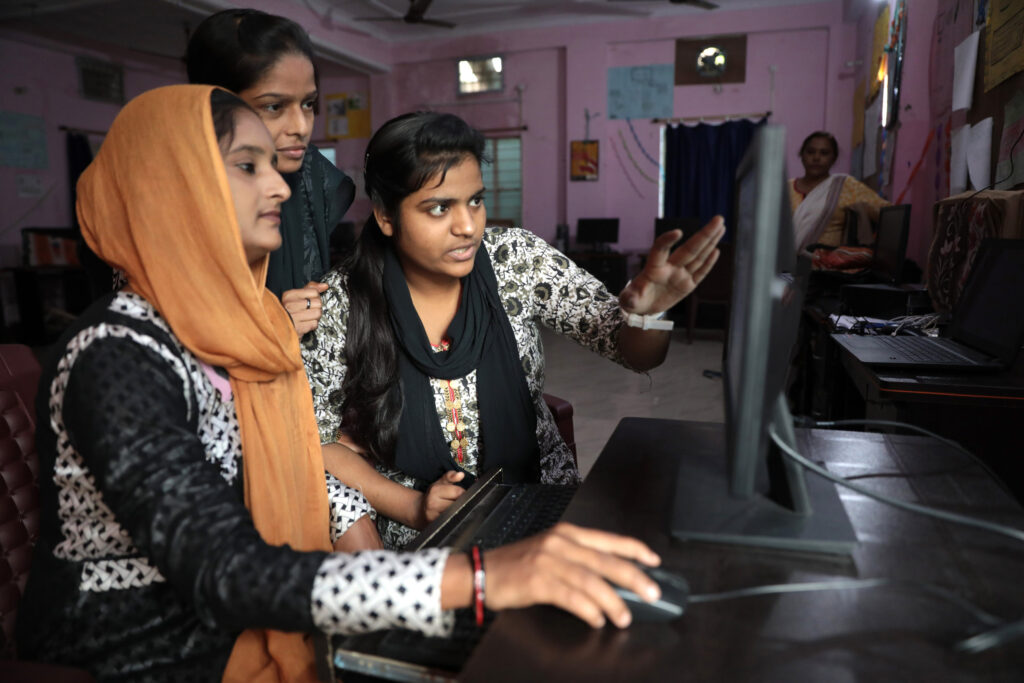
Addressing these internal conversion factors requires gender-responsive, safe learning environments, where women can experiment, learn from peers, and receive ongoing support. Effective digital literacy interventions prioritise peer-to-peer learning and demographic alignment between trainers and participants (World Bank G2Px, 2024). Based on these learnings, common digital hubs (like CSCs) can perhaps evolve beyond access points to become pedagogical spaces that reduce social stigma and enable judgment-free learning, with women-only hours or days.
These hubs could also serve as a place for community-level AI diffusion. The government has announced plans to train 5.5 lakh VLEs in AI skills. With 94.56% of Gram Panchayats already covered by at least one functional CSC, the physical infrastructure for large-scale diffusion of new technologies that can augment existing livelihoods already exists. However, any program leveraging this existing infrastructure will need to actively address internal and external factors affecting women’s use of such hubs, as well as infrastructure gaps such as power outages and unreliable connectivity that undermine reliability (Kathuria et al., 2021).
BUILDING TRUST THROUGH WOMEN OPERATORS
Research in Karnataka and Assam further shows that women are significantly more likely to use CSC services when the hub operator, the Village Level Entrepreneur (VLE), is female. Yet only a small proportion of CSCs are currently run by women VLEs, and even that figure is complicated by a “proxy problem” in which centres registered in a woman’s name are often managed by male relatives, which can, in turn, deter female customers. Studies in other geographies confirm the preference for women-led centres. In Mozambique, for example, the Business Women Connect programme trained 100 women as service agents, which created a multiplier effect that expanded the reach of digital financial services well beyond the original cohort. In Pakistan, CIRCLE Tech Hubs, designed as women-only spaces with female instructors, graduated over 10,000 women in 2023.
This is an important design consideration for ensuring common digital hubs are trusted by women in the community.
DESIGNING FOR EVERYDAY ACCESS AND ADDRESSING THE SOCIAL ARCHITECTURE
Social conditions also shape women’s engagement with local digital hubs as livelihood, entitlement, or work centres. Social conversion factors such as freedom of mobility, household responsibilities, and prevailing gender norms influence whether women can realistically access spaces like CSCs. Combined with internal conversion factors, these determine whether a woman becomes an active digital agent or remains a passive bystander even inside a functional centre. Without both, women remain “passive users” despite formal access.
Evidence from other regions highlights similar dynamics. For example, in South Africa, it was documented that even free internet at a local hub failed to attract women if the access points were not on their daily care-work routes. In Kenya, researchers found that a rural community knowledge centre’s primary users were young men aged 15–34, while elderly women and girls were almost absent, as the centre’s social environment felt male-dominated and intimidating.
SUSTAINING DIGITAL HUBS: THROUGH LIVELIHOOD PATHWAYS AND SKILLING
Another challenge is that of sustainability. Outside of government or philanthropic funding, how do such hubs sustain themselves financially? In Brazil, evidence showed that when telecentres were pushed toward financial self-sufficiency, operators rationally prioritised high-commission services, such as bill payments, over time-intensive social services, such as digital literacy training for marginalised women. Sustainability, therefore, cannot be an afterthought. If financial models are not designed with the social mission in mind from the outset, market incentives may quietly crowd out the very women these hubs aim to serve.
A key design choice that shows promise for sustained use of common digital hubs is linking digital skills to concrete livelihood opportunities. For example, a study on digital literacy and rural entrepreneurship in Nagaland found that while PMDISHA can equip participants with fundamental skills, it must be complemented by continuous skill enhancement programs and the development of digital and physical infrastructure to facilitate entrepreneurial activities. Another study has found that digital skills yield stronger outcomes when integrated with vocational training and livelihood pathways.
TOWARDS AN EVIDENCE-BASED FRAMEWORK: CALL FOR COLLABORATIONS
The core infrastructure and the target demographic for common digital hubs are both present, yet a critical gap remains in design frameworks that consciously integrate the two. This means actively recruiting and supporting women to operate these hubs as a priority, given the evidence base around the potential for this lever to increase women’s participation. It also means locating hubs where women can access them, given their mobility constraints and commuting patterns (Magoro et al., 2023). It means building in continuous support, peer learning, and follow-up into programs, since one-off workshops rarely produce lasting change (IIPA, 2021). And finally, it means linking digital skills and common hubs to real-world livelihood opportunities and improvements.
Getting these conditions right matters. But identifying which combinations of design choices work best, for which women, and in which contexts, requires stronger evidence.
Do women-led digital hubs layered onto existing infrastructure, offering AI-enabled information services, online market linkages, or distributed work opportunities, lead to measurable improvements in women’s incomes and agency? What design principles make these hubs both trusted and financially sustainable? And do features such as childcare support or micro-centres closer to women’s homes improve participation and retention?
These questions are empirical, and until they are answered rigorously, the gap between provisioning and participation will persist.
The Gender x Digital hub, in collaboration with The/Nudge Institute, under Sanmati 2.0, is inviting mission-aligned organisations to co-design and rigorously test women-led Common Digital Hub models. These hubs will be maintained and run by women from the local community and can potentially offer services such as AI-enabled information access or AI-based solutions, online market linkages, or distributed work opportunities across different geographies and institutional entry points. Going beyond a prescriptive single model, the collaboration seeks to generate causal evidence on what actually works, surface implementation challenges, and build proof that can inform large-scale policy and practice.
Interested? Please read more here.
The author thanks Mahima Taneja (Associate Director – Research & MLE) and Vaidehi Sahasrabhojanee (Policy Associate), GxD hub, for their valuable inputs and guidance.
Photo Credit: Paula Bronstein/Getty Images/Images of Empowerment
REFERENCES
CIRCLE Women Association. (2023). https://circlewomen.co/tech-hub/
Common Service Centres (CSC). (2025). Ministry of Electronics and Information Technology, Government of India. https://www.csc.gov.in/
Githinji, R. W. (2022). Impacts of a telecentre on a rural community in Kenya. https://www.researchgate.net/publication/361881623_Impacts_of_a_Telecentre_on_a_Rural_Community_in_Kenya
Kathuria, R., Kedia, M., Raj, A., Sekhani, R., & Sinha, S. (2021, November). Building an inclusive digital society for rural India. Broadband India Forum. https://broadbandindiaforum.in/wp-content/uploads/2021/12/Building-an-Inclusive-Digital-Society-for-Rural-India_Accessible.pdf
Kezhalhousa, S., Kumar, S., & Shibu, N. S. (2024). A study on digital literacy and rural entrepreneurship: Evaluating PMGDISHA’s contribution in Nagaland. https://www.researchgate.net/publication/390659031_A_Study_on_Digital_Literacy_and_Rural_Entrepreneurship_Evaluating_PMGDISHA’s_Contribution_in_Nagaland
Magoro, K., Abrahams, L., & Phahlamohlaka, J. (2023). Unlocking local digital economies through tech hubs: What we are learning from Digital Mandhwane (Public Policy Series No. 2). Learning Information Networking and Knowledge (LINK) Centre, University of the Witwatersrand. https://www.wits.ac.za/media/wits-university/faculties-and-schools/humanities/research-entities/link/documents/public-policy-series/Magoro%20et%20al%202023.pdf
Malhotra, C. (2021). PMGDISHA impact assessment report. Indian Institute of Public Administration. https://www.iipa.org.in/publication/public/uploads/article/25761684475572.pdf
Melake, T., Robinson, S., Aridi, A., & Rodriguez-Aslan, M. (2024). What works to advance women’s digital literacy? World Bank Group. https://documents1.worldbank.org/curated/en/099040225191054238/pdf/P173166-dc7a7963-3066-4151-a26e-2b987720fc1e.pdf
Ministry of Statistics and Programme Implementation (MoSPI). (2025). NSS 79th Round: Comprehensive Telecom Modular Survey (CTMS) 2023-24. Government of India. https://microdata.gov.in/NADA/index.php/catalog/239
Nemer, D. (2018). Going beyond the “T” in “CTC”: Social Practices as Care in Community Technology Centers. Information, 9(6), 135. https://doi.org/10.3390/info9060135
Rajeev, M., & Bhandarkar, S. (2022). Women online: A study of Common Service Centres in India using a capability approach. Asia & the Pacific Policy Studies, 9(3), 405–424. https://doi.org/10.1002/app5.360
The Economic Times. (2024, December 31). Free AI training to 5.5 lakh village entrepreneurs soon, says Ashwini Vaishnaw. https://economictimes.indiatimes.com/news/india/free-ai-training-to-5-5-lakh-village-entrepreneurs-soon-says-ashwini-vaishnaw/articleshow/122582935.cms
Author

Deepti
Deepti
Deepti is a Research Associate at the Gender x Digital (GxD) hub at LEAD. Her work focuses on analysing gender disparities in labour markets and technology adoption, using large-scale datasets to generate policy-relevant insights. She has experience in quantitative analysis, computational methods, and labour economics, and is particularly interested at the intersection of gender studies, labour economics and public policy. Before joining LEAD, Deepti built a strong foundation in data-driven research and policy analysis through her academic training in economics and computational social science. She holds a Master’s degree in Computational Social Science from IIT Jodhpur and a Bachelor’s degree in Economics from Ambedkar University, Delhi.