
Building for the Women Powering the Last Mile: Why Digital Job Aides Matter
Can digital and AI tools ease the workload of frontline women workers? Vaidehi Sahasrabhojanee from the Gender x Digital hub explores how gender-intentional job aides can support last-mile service delivery.
Author: Vaidehi Sahasrabhojanee | GxD hub
Building for the Women Powering the Last Mile: Why Digital Job Aides Matter
Can digital and AI tools ease the workload of frontline women workers? Vaidehi Sahasrabhojanee from the Gender x Digital hub explores how gender-intentional job aides can support last-mile service delivery.
Author: Vaidehi Sahasrabhojanee | GxD hub
Type
- Blog
Themes
- Digitisation, Frontline Workers, Livelihoods
Date
- F, Y
Share
Imagine a Community Resource Person (CRP), Geeta, based in a rural community in Uttar Pradesh. After forming Self-Help Groups (SHGs) in her assigned villages, she handholds bookkeepers with financial record-keeping, facilitates regular group meetings, and helps SHG members open bank accounts*. She also travels to assigned villages every alternate month to assess agricultural conditions, screen training videos, and train farmers. She is, all at once, a community organiser, financial coach, and agricultural extension worker. She is also a Class 10 pass who was using a shared family phone until recently. And now, her role entails collecting and maintaining MIS data from SHGs and Village Organisations at regular intervals, and ensuring its accuracy. What should digital tools designed around the specific needs and contexts of Geeta and similar community workers look like in practice?
India’s livelihood ecosystem is powered by approximately 4.8 lakh community intermediaries or frontline workers, most of them women, working on the ground across health, agriculture, finance, and livelihoods. Under the National Rural Livelihoods Mission (NRLM) and its state-level counterparts, the State Rural Livelihoods Mission (SRLMs), a large, decentralised cadre system operates at the last mile, comprising Community Resource Persons (CRPs) who lead social mobilisation, SHG formation, and early-stage handholding; SHG bookkeepers and office bearers who manage accounts and records; and federation-level actors within Village Organisations (VOs) and Cluster Level Federations (CLFs) who oversee governance and fund disbursement. Alongside them are specialised/livelihood cadres and extension workers, such as Krishi Sakhis, Pashu Sakhis, and Bank or BC Sakhis, who support agricultural extension, livestock, and financial service delivery. In parallel, ASHA and Anganwadi workers together form a significant share of India’s care economy.
These community cadres form critical last-mile infrastructure through which welfare services reach households in rural and remote areas. Evidence highlights that these cadres operate under significant structural and operational constraints. A 3ie study (2021) documents that community SRLM staff and CRPs are highly motivated but overstretched, facing bureaucratic overload, staff shortages, target-driven reporting pressures, and limited time and resources to provide sustained handholding. As a result, they are expected to manage complex administrative, coordination, and facilitation tasks while working within fragile group dynamics, weak institutional linkages with banks and panchayats, poor financial incentives, and limited support from higher-level federations.
In recent years, there has been a push to digitise public services, with the potential to streamline processes, reduce paperwork, and ease the workload of last-mile workers. Evidence from studies shows that when digital and AI tools provide actionable, immediate feedback rather than periodic administrative reports aimed at supervisors, community workers report higher confidence, stronger ownership of their work, and more proactive decision-making. AI may further expand this potential. According to the International Labour Organization (2023), AI is more likely to augment existing jobs (instead of automating them) for both men and women across income groups, especially in low and middle-income countries. This presents an opportunity to enhance and augment the work that community cadres currently undertake: by using AI to bring in efficiencies and deliver contextual, multilingual advisory and services.
However, what does this mean for the cadres on the ground? The reality on the ground is even more complex. ASHA workers, for example, are increasingly engaging with a range of digital platforms and applications including ASHApay app, Divyang Sarthi App, WhatsApp for sending information to health officials, ANM, ASHAs, NCD-GOI app, TB Survey, Ayushman Bharat PM-JAY App, Mobile Academy, and Zoom and Microsoft Teams, in addition to their ever-increasing daily tasks (Sreerupa, 2024). As digital processes become embedded within welfare delivery, this additional layer of digital tasks requires balancing digital reporting and coordination alongside existing program responsibilities. For instance, an IWWAGE study (2025) highlights that while digitisation is intended to improve monitoring, transparency, and financial management, it has also increased the cognitive and administrative burden on these cadres, especially women, many of whom have low levels of digital and financial literacy and face mobility and connectivity constraints. This should further be placed in the context of the persistent gender digital divide in India. Despite recent progress, there is a notable gender gap in smartphone ownership; only 37% of women use mobile internet in India, compared to 53% of men, with lack of skills, affordability, and safety and security concerns as the top reported reasons for non-use.
Frontline workers and community intermediaries are also actively engaged in maintaining digital systems while simultaneously building digital skills in the process. In practice, this may take the form of improvising entry records by maintaining parallel paper systems, using personal devices, and troubleshooting using informal WhatsApp groups. Literature describes this phenomenon as “system-building”, as frontline workers continuously sustain infrastructure through everyday coordination, adjustment, and improvisation that dashboards do not account for. In doing so, they are acquiring digital skills, navigating apps, troubleshooting, and communicating across platforms. This signals that these workers are not passive users of technology, but play a critical role in keeping it contextually grounded.
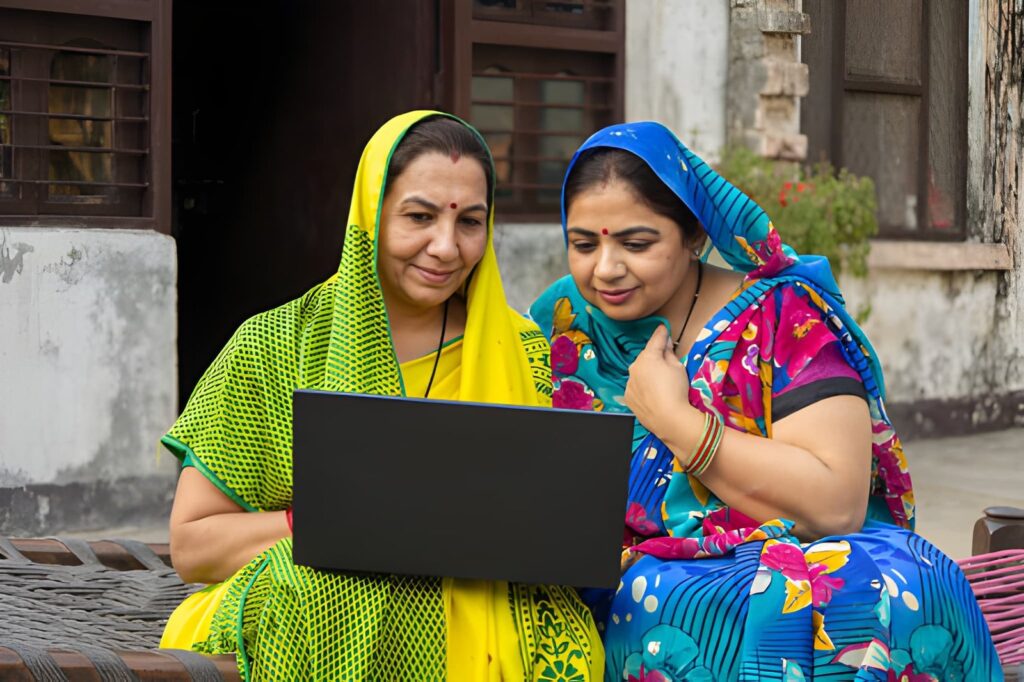
This presents an untapped opportunity: job aides in the form of digital or AI tools built for community intermediaries should be centred around their lived realities, current capabilities, and needs. We need to, for example, ask: What would a digital job aide designed specifically for the needs and context of a Pashu Sakhi (or other frontline community cadres), with a shared smartphone, patchy network, limited digital skills, and high workload look like?
The need of the hour is a shift in design logic: moving from compliance and upward reporting to developing gender-intentional digital job aides for frontline workers to meaningfully support their day-to-day work. Instead of being designed for the system above them, these digital or AI-driven job aides should streamline community cadres’ work, reduce cognitive load and administrative burden, and support them in delivering contextualised and relevant advice and services. Evidence suggests that this could be achieved through simplified interfaces with local-language integration, voice-first interaction that reduces manual entry, and contextual advisory tailored to the worker’s specific role. Moreover, layering in gender-intentional features, such as voice-first interfaces, visual prompts, offline functionality, and actionable feedback into digital and AI solutions or tools for frontline women cadres can further ensure adoption and meaningful use. However, what remains unanswered is whether AI-driven or digital job aides, when designed with gender intentionality, improve work efficiency, digital skills, or the incomes of livelihood intermediaries/community cadres, and whether this in turn drives any community-level outcomes.
The author would like to thank Mahima Taneja, Associate Director – Research & MLE, GxD hub, for her inputs and guidance.
Photo Credit: Dimple Bhati/Getty Images
References
Bhanjdeo, A., Narain, N., Sheth, S., & Walton, M. (2021). Understanding India’s Self-Help Groups: An organisational anatomy of functionality in a district in Madhya Pradesh. International Initiative for Impact Evaluation (3ie). Working Paper 46.
https://3ieimpact.org/sites/default/files/2021-08/WP46-SHG-Madhya-Pradesh.pdf
Deendayal Antyodaya Yojana, National Rural Livelihoods Mission. Master circular, Part 1. Ministry of Rural Development, Government of India.
https://umed.in/documents/DAY%20NRLM%20MASTER%20CIRCULAR%20PART%201.pdf
GSMA. (2024). The mobile gender gap report 2024. GSMA Connected Women. https://www.gsma.com/solutions-and-impact/connectivity-for-good/mobile-for-development/gsma-intelligence/reports/the-mobile-gender-gap-report-2024/
Ismail, A., Yadav, D., Gupta, M., Dabas, K., Singh, P., & Kumar, N. (2022). Imagining caring futures for frontline health work. Proceedings of the ACM on Human-Computer Interaction, 6(CSCW2), 1-30.
https://doi.org/10.1145/3555581
Singh, A., Jose, J., Chouhan, K., Agarwal, P & Kurian, V. (2025). Digitisation of Self-Help Groups in India. What Works to Advance Women and Girls in the Economy (IWWAGE).
https://iwwage.org/wp-content/uploads/2019/08/IWWAGE-SHG-Digitization-June-25.pdf
Lok Sabha. (2025). Unstarred question no. 5611. Digital Sansad, Parliament of India.
https://sansad.in/getFile/loksabhaquestions/annex/184/AU5611_6NyLp2.pdf?source=pqals
Ministry of Statistics and Programme Implementation. (2025). Comprehensive modular survey: Telecom. Government of India.
https://www.mospi.gov.in/sites/default/files/publication_reports/CMST_report_m.pdf
Okolo, C. T., Agarwal, D., Dell, N., & Vashistha, A. (2024). ” If it is easy to understand then it will have value”: Examining Perceptions of Explainable AI with Community Health Workers in Rural India. Proceedings of the ACM on Human-Computer Interaction, 8(CSCW1), 1-28.
https://doi.org/10.1145/3637348
Sarangi, A., Sahasrabhojanee, V., Taneja, M., & Jhurani, Y. (2025). Decoded: Women and the Future of Work.. Gxd hub, LEAD at Krea University (IFMR).
https://gxdhub.org/wp-content/uploads/2025/11/decoded-insights-women-future-digital-work-india.pdf
Sreerupa., Makkad, S., & Rajeev, A. (2024). Digitalisation at the Frontlines: ASHAs’ Experiences across Haryana, Rajasthan, Kerala, and Meghalaya. Institute of Social Studies Trust (ISST).
https://164.52.210.154/jspui/bitstream/123456789/1849/1/Digitalisation%20at%20the%20Frontlines
Verdezoto, N., Bagalkot, N., Akbar, S. Z., Sharma, S., Mackintosh, N., Harrington, D., & Griffiths, P. (2021). The invisible work of maintenance in community health: challenges and opportunities for digital health to support frontline health workers in Karnataka, South India. Proceedings of the ACM on Human-Computer Interaction, 5(CSCW1), 1-31.
Author

Vaidehi Sahasrabhojanee
Vaidehi Sahasrabhojanee
Vaidehi Sahasrabhojanee is a Policy Associate at the Gender x Digital (GxD) hub at LEAD. Her work focuses on translating research and evidence into actionable policy insights, with experience in literature reviews, impact evaluations, and qualitative research. She is particularly interested in questions at the intersection of gender, technology, and development. Before joining LEAD, she worked with the Quality Council of India, where she gained experience in government relations, research, and evaluation. Vaidehi holds a Master’s degree in Public Policy from Christ University, Bengaluru, and a Bachelor’s degree in Sociology from the Manipal Centre for Humanities, Manipal.