Established in early 2024, the Gender X Digital hub (GxD hub) is a crossdisciplinary initiative dedicated to advancing meaningful digital connectivity among women and girls.
Who we are
Housed at IFMR’s action-oriented research centre LEAD, the hub is strategically situated within the dynamic and innovative ecosystem of IFMR/Krea University. The GxD hub benefits immensely from the deep expertise, resources, and collaborative spirit that define our community, which provide a strong foundation for its initiatives.
Bringing together the ecosystem’s expertise, GxD hub will serve as a catalyst for co-creating gender-intentional digital solutions and policies.
Institutionalise gender-intentional and overall inclusive approaches across digital platforms, DPIs, AI-assisted tools and service delivery systems.
Strengthen ecosystem capacity to design and implement solutions that advance women’s participation, agency, and economic empowerment in the digital age.
Levers
Technical Advisory
Technical support for government depts on design and implementation of gender-intentional digital policies, programs.
Evidence Generation & Synthesis
Generate evidence and large-scale data on user realities and inform targeted interventions, surface cross-cutting insights and best practices, in collaboration with partners
Ecosystem Development
Strengthen inclusive, gender-intentional digital programming through collaboration, knowledge exchange, and the application of shared learnings across the ecosystem.
Our Partnership Ecosystem
Our partnership approach is organized into three key tracks
We work closely with government partners at both the national and state levels to advance gender-intentional approaches in digital policy and programs.
Ministry of Electronics and Information Technology (MeitY)
Our engagement with MeitY and its associated bodies, including a formal MoU with NIELIT, is focused on building inclusivity into the Ministry’s work through multiple strategies. This includes providing technical inputs on gender-responsive approaches, supporting institutional processes, and facilitating partnerships that advance women’s participation in the digital economy.
Government of Meghalaya
At the state level, we are partnering with the Government of Meghalaya to generate evidence on women’s digital access and usage. By combining household survey data with information on connectivity infrastructure, this study highlights barriers and opportunities for meaningful digital inclusion in the state. The findings are designed to inform state investments and national-level decision-making.
Through research and evaluation partnerships, we generate evidence on gendered inclusion gaps in digital platforms and programmes, supporting partners to design, refine, and scale more inclusive digital interventions.
Women and Digital Work | Nudge Institute
Sanmati 2.0, a research and action initiative by the hub and The/Nudge Institute aims to build the evidence base on approaches and models that can increase women’s participation across India’s evolving digital value chain.
Digital Loan Repayments for SHG members | SERP, Yugantar
We are partnering with SERP and Yugantar to assess whether enabling SHG women to make loan repayments through digital methods, both app-based and voice-based, can strengthen financial autonomy, reduce transaction losses, and build trust in digital financial systems, particularly in shared-phone contexts. The collaboration supports an ongoing pilot with light-touch tracking and group-level verification tools integrated into existing MIS systems, generating evidence on usability, safety, and accountability to inform future scale-up without increasing operational burden.
This track focuses on fostering a collaborative ecosystem to advance inclusive, gender-intentional digital programmes through shared learning, knowledge exchange, and embedded practice.
Women’s Work and AI: Unlocking Potential, Bridging the Divide
As part of its Future of Work series, IWWAGE and the hub organised a timely conversation around strategies for enabling women’s participation in India’s workforce as we confront a constantly evolving future of work. The series highlights gender-responsive principles in various thematic areas to enable and enhance women’s workforce participation.
Measuring Digital Access in India | Partner Meet 1
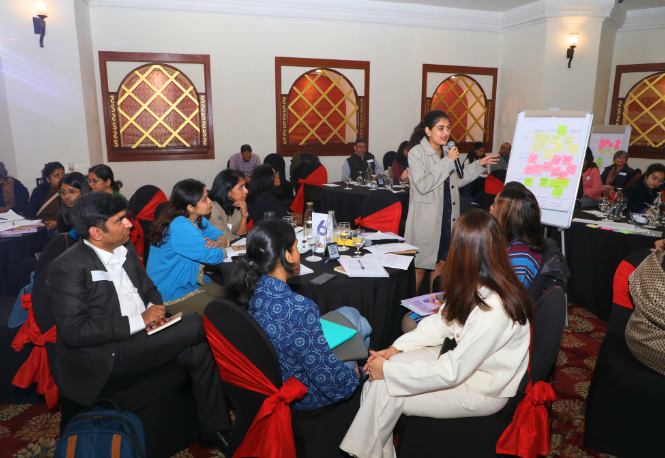
Along with the University of Cape Town and Johns Hopkins University, we organised a workshop to strengthen existing measurement frameworks for digital access in India and foster cross-sector collaboration. The workshop also brought together GxD hub’s partners working on advancing digital inclusion in India.
Sharon Buteau combines expansive experience of over 18 years of experience in research and international development with more than 7 years in digital financial services and financial inclusion. She is deeply passionate about promoting meaningful digital access and opportunities for women and girls, and identifying effective solutions to promote enterprise growth and unlock the untapped potential of micro and small businesses.
At LEAD, Sharon focuses on bringing together the right combination of talent, expertise, and stakeholders to ensure that investments and efforts are aligned with desired goals. She brings significant expertise in co-creation, collaborative frameworks, and ground-up data, leveraging these to drive transformative socio-economic outcomes for individuals, households, and enterprises. She holds a Master’s degree in Economics from the Université du Québec à Montréal and a Master’s degree in Social Research Methods from the London School of Economics.
Mahima Taneja
Associate Director, Research & MLE
Mahima Taneja leads research and monitoring, learning & evaluation for the Gender x Digital (GxD) hub at LEAD. She brings over a decade of experience in research and evaluation, with work spanning gender equality, urban policy, WASH, and adolescent sexual and reproductive health. Previously, Mahima worked with the Gates Foundation in India, managing multiple evaluations under the Women’s Economic Empowerment and Inclusive Financial Systems portfolios. She has also held roles at Sambodhi, ISST, and Oxfam India, and is an active member of the Evaluation Community of India.
Mahima holds an M.A., M.Phil., and Ph.D. in Political Science with a specialisation in Gender Studies from Jawaharlal Nehru University, New Delhi, where her doctoral research explored the gendered politics of urban public spaces. She has taught at the University of Delhi and published widely on feminist evaluation, inclusive cities, and women’s movements in India.
Preethi Rao
Director, Partnerships & Outreach, LEAD at Krea University
Preethi Rao oversees the leveraging evidence function (collaborations, training, learning and communications, and innovations) and contributes to strategic decision-making at LEAD. Preethi has served the organisation in various capacities, such as Associate Director, Head – Innovation, Senior Operations Manager, and Researcher (MSME).
As an Innovation Champion, Preethi drives new initiatives and conceptualises emerging areas of interest for the organisation. She has overseen large-scale field data collection and digitisation operations across more than ten states, and previously directed the Jaipur Digital Payments Lab at Catalyst, managing on-ground execution, partner and stakeholder relations, donor liaison, monitoring and evaluation, and programmatic learning outputs.
Preethi holds a Master’s degree in Management from IFMR Graduate School of Business, with a focus on Finance and Marketing. Her work spans interdisciplinary research on access to finance for small and medium enterprises, the impact of macroeconomic policies on low-income populations, and projects in open data, financial inclusion, and MSMEs.
Diksha Singh
Associate Director, Communications & Outreach, LEAD at Krea University
Diksha Singh is a certified communications and knowledge management specialist with 12+ years of experience across research, advocacy, and innovation programs. She is passionate about elevating the voices of Global South actors and expanding meaningful digital access for women and girls. At LEAD, she oversees the learning and communications portfolio, working closely with the program teams to drive impactful narratives and data-led advocacy campaigns. Her work spans financial wellbeing, SME growth, women’s empowerment, digital inclusion, and mental health.
Diksha has supported policy outreach for a USAID-funded program promoting digital payment adoption and synthesized evidence to inform the Ministry of Electronics and Information Technology’s digital inclusion policies. She holds a Master’s degree in Economics from the University of Mumbai and has also served on the Board of Directors of SEEP Network, representing over 100 development-sector organisations.
Ajita Singh
Stakeholder Engagement Specialist, GxD hub
Ajita Singh is the Stakeholder Engagement Specialist at LEAD’s Gender x Digital hub, driving partnerships with government bodies and stakeholders to advance inclusive digital transformation. She works at the intersection of gender, philanthropy, and digital inclusion, designing programmes that prioritise equity and inclusion. Previously, she has worked with Tata Trusts, Reliance Foundation, and Nasscom Foundation, building strategic and financial partnerships with governments, donors, grassroots organisations, and technical agencies to enable systems-level change.
Ajita is a Chevening Scholar and holds an MPhil in Development Studies from the University of Cambridge, a PG Diploma in Liberal Arts from Ashoka University, and a Bachelor’s degree in Philosophy from Miranda House, University of Delhi.
Vaidehi Sahasrabhojanee
Policy Associate, GxD hub
Vaidehi Sahasrabhojanee is a Policy Associate for the Gender x Digital (GxD) hub at LEAD. Previously, she was associated with the Quality Council of India, where she gained experience in government relations, research, and evaluation.
Vaidehi holds a Master’s degree in Public Policy from Christ University, Bangalore, and a Bachelor’s degree in Sociology from the Manipal Centre for Humanities, Manipal. She is deeply passionate about mental health and human rights, with a keen interest in exploring their intersection within the framework of government policies.
Deepti
Research Associate, GxD hub
Deepti is a Research Associate with the Gender x Digital (GxD) hub at LEAD. Her work focuses on analysing gender disparities in labour markets and technology adoption using large-scale datasets and quantitative research methods. Deepti holds a Master’s degree in Computational Social Science (with a specialisation in Computational Economics and Mathematics) from IIT Jodhpur and a Bachelor’s degree in Economics from Ambedkar University, Delhi. Her research interests lie at the intersection of labour economics, gender studies, and public policy.
Sonam Gupta
Research Manager (GxD hub)
Sonam Gupta is a Research Manager with LEAD’s Gender x Digital (GxD) hub, where she works across research, evaluation, and programme design to generate evidence for inclusive and impactful development interventions. Previously, she was Deputy Research Manager at Sambodhi, contributing to mixed-methods evaluations and impact assessments. She has also worked with SEWA Bharat and 60 Decibels, supporting monitoring, evaluation, and learning (MEL), data collection, and research to inform programmes and capture grassroots perspectives.
Sonam holds a Master’s degree in Environmental Studies from Nalanda University, with a specialisation in community livelihoods. She is also an alumna of the Urban Fellows Programme at the Indian Institute for Human Settlements (IIHS), where her work focused on women’s health awareness in low-income urban communities.
Amnesty LeFevre
Associate Professor, University of Cape Town and Director, EDiT
Amnesty LeFevre is the Director of the Evidence for Digital Transformation (EDiT) consortium. She has nearly 30 years of experience conducting large scale evaluations of public health and development programs in over twenty countries globally. Her work explores the cost, differential reach, and impact of digital health innovations on development and health outcomes. She leads multidisciplinary research teams working to generate robust, timely evidence to inform the design and impact of large scale digital solutions.
Anjora Sarangi
Consultant, Gender x Digital (GxD) hub
Anjora Sarangi is a social scientist and independent research consultant with 11 years of experience in qualitative research, measurement and evaluation, strategic planning, and project management in gender and digital inclusion. Her work spans women’s economic empowerment, maternal and child health, digital health, and health systems strengthening. She is currently engaged with the Gender x Digital (GxD) hub on an action research project mapping digital and AI data work and co-creating solutions to expand women’s digital work participation in rural India. Previously, she has worked with the University of Cape Town, Johns Hopkins University, and BBC Media Action on gender and digital inclusion initiatives across India, Kenya, and Nigeria.
Farzana Afridi
Professor of Economics and Head, Economics and Planning Unit, Indian Statistical Institute (Delhi) | Head, Digital Platforms & WEE, LEAD at Krea University
Farzana Afridi is a Professor of Economics at the Indian Statistical Institute (Delhi) and a Research Fellow at IZA (Bonn). Her research sits at the intersection of development and labor economics, with a focus on gender and social identity, human capital, and governance. She works extensively with governments, nonprofits, and industry partners to design and evaluate field-based interventions using administrative data and randomized experiments. She leads the Digital Platforms and Women’s Economic Empowerment program, funded by the Gates Foundation, aimed at strengthening women’s agency on digital labor platforms. Her work has been supported by IGC, DFID, CAGE, IZA, UNU-WIDER, the Hewlett Foundation, and others. She is also a recipient of the National Mahalanobis Memorial Medal.
Sara Chamberlain
Partner, 2X Digital
Sara Chamberlain is a Partner at 2X Digital with over 25 years of experience in digital development, including extensive work designing interventions for women in low-resource settings in India. She is a globally recognised leader in gender equity and digital inclusion, with expertise spanning digital health, livelihoods, and skills development. Her programs have reached millions of women, demonstrating cost-effective impact at scale and earning multiple global accolades, including three GSMA Global Mobile Awards and a Microsoft Education Award. Based in India, she works closely with governments, donors, UN agencies, civil society organisations, and international networks, providing strategic support to implementers across Asia and Africa.
Tara Chklovski
Founder, CEO, Technovation
Tara Chklovski is the founder and CEO of Technovation. Inspired by her experiences growing up in India and working as an aerospace engineer, she developed an education model that combines mentorship, real-world problem solving, and entrepreneurship to prepare young women for leadership in technology. Named by Forbes as “the pioneer empowering the incredible tech girls of the future,” she has built Technovation into a global movement reaching over 450,000 participants across 120+ countries. Through Technovation and The AI Forward Alliance (TAIFA), her work focuses on preparing millions of young women to lead in AI innovation and address global challenges.
Urvashi Aneja
Founder and Director, Digital Futures Lab
Urvashi Aneja is the Founder and Director of Digital Futures Lab (DFL), one of India’s foremost think tanks focused on the societal impacts of emerging technologies. She is a leading researcher, policy strategist, and entrepreneur shaping the global conversation on AI ethics and policy. She currently anchors research on AI evaluation in low-resource contexts and policy strategising on multistakeholder approaches to AI governance. Urvashi is a trusted advisor to governments, international organisations, and industry on digital and AI policy. She holds an MPhil and PhD in Politics and International Relations from the University of Oxford.